Category: Blog

  • PRACTICE STATE EXAM: MY EXPERIENCE

    Hey 6th years,

    I know some of you are anxious and that’s okay. The last stretch to the end gets really hard but it’s gonna be better than you think. Let’s talk practice state exam.

    So this one had me SWEATING. It’s a lottery draw?? And what do you mean we get external examiners? Everyone kept saying it’s just a formality and I don’t need to stress to much about it. As a matter of fact, some people said they didn’t even really read. Just brushed up on a few concepts the day before. Well, I would like to announce: It is not just a formality. I repeat, IT IS NOT JUST A FORMALITY! IT IS VERY POSSIBLE AND NOT THAT DIFFICULT TO FAIL THIS EXAM.

    You are going to receive all the details to get to your exam days before- maybe you already have. The exam will be held over the course of a week. The “lottery” is organised by the RO. In the morning, we logged on to a Teams meeting and heard our names called and our assigned departments. I got internal medicine first department. Just my luck right. Once I logged off that call, I opened my ECGs again and familiarised myself with some diagnoses, treatments and such. Went over some more cardiology, haematology and endocrinology. Gastroenterology has never been much of problem for me so I skipped that.

    My practical was with Dr Kenyeres in the cardiology department. It was 4 of us he examined, and we were assigned to different patients. We were provided with our patient files and got to interview our patients. I got a 50 year-old male patient, who was hypertensive with new-onset atrial fibrillation. The medical history was unremarkable. The ward was rather busy so we were not really questioned on our examination techniques (I guess they also assume that was tested in the internal medicine final exam). We just had to present the patient case and talk through everything.

    When it was my turn, I spoke about the patient, giving both the history and physical exam uninterrupted. Then he started to ask questions. 

    He asked about the ECG strip in the patient file; I had to describe the rate and rhythm, and abnormalities. I had no issues here. The next question asked was about what to do with a patient like this on arrival. He asked about initial exams and how we diagnose. He asked what lab tests are run and what other exams to do. At some point, I mentioned echocardiography would be important and he asked what type: TTE or TEE, and why.

    Up till here, everything was cool. He asked what next after establishing the diagnosis as a.fib. I mentioned we had to check for possible thrombus. Where, he asked. I said the left atrium. Where in the left atrium? I couldn’t answer this… The answer is the left atrial appendage. And with what? The echo. Once again, what kind of echo? TEE for better visualisation. He asked about the two kinds of treatment in heart rhythm disorders. That’s rate and rhythm control.

    I’ll list the rest of the questions here for quick viewing.

    Questions: 

    • How do we know which to use? I don’t even remember what I said here. I might have mentioned something about being symptomatic. The better answer is haemodynamic instability and inappropriate ventricular rate for rate control. I think for rhythm control, was structural dysfunction like dilated atrium. 
    • What do we do use for rate control?: Beta blockers and (non-DHP) CCBs. 
    • What else? I couldn’t answer and he gave me a hint. (Hint: It was previously commonly used in heart failure). I said digoxin. 
    • When do we not bother with checking for thrombus? We don’t need to check it if patient is already anti-coagulated or if a. fib resolves in 48 hours.

    SIMPLE NOTE BECAUSE I JUST LEARNED THIS: If you have a patient with a. fib. and no prior cardiovascular history, investigate the patient’s activity in the past few days. Alcohol causes sympathetic hyperactivity and can induce this. A patient may come in with palpitations after a period of binge-drinking. It’s associated with holidays and weekends, especially long-weekends- that sort of thing. For this reason, a. fib. in this context is called holiday heart syndrome. There’s typically no need for anti-arrhythmics in this case as it is self-resolving. Read more here.

    • What do we use for rhythm control? Flecainide, propafenone, amiodarone. 
    • What non-pharmacological methods can we use? Electric cardioversion. 
    • For a bonus question, he said there was something else. I also did not know this and the answer is pulmonary vein isolation- which makes sense when you remember that the origin of a. fib is the pulmonary veins.

    We all got our grades and went upstairs for the oral part.

    For the oral exams, we were being examined by a gastroenterologist, a neurologist, a neurosurgeon and a psychiatrist. Everyone went in nervous and came out smiling so it was a bit of a comfort. I was the third to the last to go.

    • First question was about my thesis. So I walked through it briefly. Many nods of approval.  
    • The gastroenterologist asked all about a. fib again. I just repeated everything. He asked what we check for in lab work. I added that we could check thyroid hormones. We segued into hyperthyroidism.
    • What do we check in suspected hyperthyroidism? What direction does TSH and T3/fT4 go?
    • What else can we check? Autoantibodies- list them.
    • How do we treat? I said metamizole, instead of methimazole. He pointed it out but he understood what I was trying to say. Just be careful to avoid little blunders like this. Also mentioned propylthiouracil and beta blockers. 
    • Neurosurgeon asked how we manage pain in extended spontaneous fracture causing pain. This was a bit confusing for me so I started a whole lecture about the WHO pain ladder. After a good 90 seconds of talking, he goes, “Yes, yes that’s all good but I meant surgically.” It was such a facepalm moment because as the surgeon, OF COURSE HE MEANT SURGICALLY. It didn’t matter much because I still didn’t know what exactly he was looking for. The answer he expected was vertebroplasty, but he didn’t give me a hard time about it (maybe because I demonstrated that I at least knew something about pain management? I’m unsure.)
    • The neurologist asked about headaches. So I went into them: the classifications and types- primary (migraine, tension headache, cluster headache) and secondary (mass-occupying lesions, haemorrhage, infection, medications, etc, etc). I started to describe them in-depth, starting from migraines and she stopped me.
    • The psychiatrist was the last and asked how I would treat depression: pharmacotherapy and psychotherapy. I mentioned all the antidepressant groups and drugs. He stopped me midway and went on to psychotherapy. I mentioned music, art, group. He stopped me. They thanked me and asked again about my thesis. Then it was over. I also came out smiling.

    Now, I’d like to share some other experiences my peers shared at the time.


    PRACTICAL: Internal medicine 2nd department

    ORAL: I was examined by a neurology, OBG specialist, internist and thoracic surgeon.

    Patient had bilateral leg oedema due to liver failure.

    I was asked about the physical examination of the liver. I just mentioned that it’s firm, nodular surface, round edge, not painful and did not have to perform it in front of the doctor.

    Then we went upstairs and waited for oral.

    They called names, and asked the female students to start first. When it was my turn, I went inside and Dr. Kovács gave the other examiners the details about my patient, after which they all asked relevant questions:

    • Dr. Kovács: What are the most common causes of bilateral leg edema? ANS: HCV, alcoholic liver failure, nephrotic syndrome.
    • Thoracic surgeon: You have a patient scheduled for elective surgery due to cholelithiasis, and you notice she has liver cirrhosis. Do you perform the surgery? Why or why not? ANS: Do not perform due to an increased risk of coagulopathy as a result of end stage liver failure.
    • Gynaecologist: Do you know any cause of liver failure in pregnancy? ANS: HELLP syndrome, treated by immediate delivery.
    •  Neurologist: What is a neurological sign of liver failure? ANS: Asterixis tremor and coma due to hepatic encephalopathy.
    • Neurologist: Is asterixis a true tremor? ANS: No. And then I proceeded to speak about clonus, how it is triggered and the differential diagnosis of tremors.
    • Neurologist: Back to asterixis, do you know the types of tremor? ANS: Resting, intention, postural, psychogenic, etc.
    • Neurologist: Do you know any drugs that can also cause tremor? ANS: anti-psychotics, SSRIs, chronic alcohol abuse…
    • Neurologist: How can you differentiate between drug-induced and Parkinson’s disease tremors? ANS: In Parkinson’s the tremor is asymmetric. 

    Then they asked what I want to specialise in, where, etc. It was all super fast, not even 10 minutes.


    PRACTICAL: Psychiatry department

    ORAL: I was examined by a paediatrician, internist, neurologist (Dr. Faludi) and psychiatrist (Dr. Herold).

    Patient was diagnosed with borderline personality disorder.

    • Dr. Herold: List the types of personality disorders. What is the diagnostic criteria for MDD? I couldn’t list everything perfectly but it was totally fine.
    • Dr Herold: What medications are used for borderline PD and MDD?
    • Paediatrician: Bacterial meningitis: the most common pathogens, clinical signs, CSF findings.
    • Internist: Causes of metabolic acidosis. I couldn’t say much but it was okay.
    • Neurologist: Differences between convulsive syncope and a seizure. Causes of convulsive syncope, as well as the most important cause. I said cardiovascular because it can be an emergency, but he said no it’s the vasovagal syncope caused by emotional stress. I’m not sure why… 

    Overall, the psych department asked me more detail than expected and other departments less. But missing some details did not affect my grade. It took me about 20 minutes.


    PRACTICAL: Surgery department

    ORAL: I was examined by a surgeon, psychiatrist, neurologist and cardiology.

    Patient had pectus excavatum. We were given information about the patient and there were no separate examination on our physical examination techniques. I only had to present the case in front of the committee and answer some questions regarding the case.

    • Surgery questions: Give me 3 indications for surgery in this case. What is the best age to perform this surgery? What is the Haller index? What are other procedures are performed for pectus excavatum? Is the metal plate inside the patient permanent? If no, how long do you keep it in for? 
    • Psychiatry questions: List all the anti-depressants that you know. What other drugs can be used different types of depression and co-existing symptoms? What he meant was how do you treat other conditions like insomnia, anxiety, physical symptoms of depression, seasonal depression, etc. What are the side effects of the different antidepressants? Other indications for anti-depressant use. Which drugs can be used alternatively when avoiding certain side effects? Non-pharmacological ways to treat depression.
    • Neurology questions: What is myasthenia gravis? What antibodies are responsible for the disease? Types of MG and typical symptoms. What are the early symptoms and complaints of an MG patient? What physical examinations can be performed for diagnosis? How can you confirm the diagnosis?  How do you treat? Why do we gradually increase the dosage of steroids rather than giving high dose? What immuno-modulatory drugs do we use? 
    • Cardiology questions: What are the symptoms and clinical findings of a myocardial infarct? List some complications of MI. What are the ECG findings?


    The exam in itself was not difficult in any way, but there were times where I wasn’t sure if I was doing well or not. Questions were mostly open-ended (e.g., explain, list, etc.) and I ended up dominating most of the conversation. The examiners did not interrupt me while I spoke, nor did they give affirmative nods or comments. The exam took about 15 to 20 minutes in total. After the exam was over, they called out names and announced grades in front of everyone. No one got a grade lower than a 4.


    PRACTICAL: Internal medicine 1st department

    ORAL: I was examined by a cardiologist (Dr. Kalman), neurologist (Dr. Ács), a radiologist and a gynaecologist (guest specialist).

    Patient came to the hospital with symptoms of hyponatraemia induced by indapamide, and shingles. The practical exam was a regular internal medicine examination. I was asked to examine the heart and lungs. She asked about murmurs and where they would radiate to. She asked where I would expect to hear tuberculosis in the lungs. ANS: apex. There’s a German name for it which I didn’t know but apex was accepted. She asked what the lung sounds you would hear in pneumonia, pneumothorax and heart failure were. She asked about spleen examination and how it is described. She asked what side of the abdomen you start palpating from.

    • Q: Summarize her history.
    • Q: Patient has hypertension and diabetes. Name the drugs used to treat both. 
    • Q: What drugs can be used in heart patients? I mentioned SGLT2, DPP4, GLP1 
    • Q: Where can it be used? Kidney failure
    • Q: What do you think why this patient has and why? ANS: Hyponatremia due to diuretics (indapamide)
    • Q: Name the side effects of thiazides and thiazide-like diuretics.
    • Q: Differential diagnosis in hyponatremia. I listed vomiting, diarrhoea, burns, SIADH, certain medications.
    • Q: Treatment of hyponatremia, and what to monitor when correcting.
    • Q: Complications of hyponatraemia in the patients. ANS: seizures. Patient was brought to ER after grand-mal seizures.
    • Q: What do you know about varicella? Virus, clinical manifestation, where it lays dormant and what causes it to re-activate, the pattern of skin lesions and why, and the therapy.
    • Q: We’ve sent her for imaging of all her systemic organs. Why do you think that might be? ANS: malignancy 

    She was very helpful and gave a lot of hints that were important in the oral exam. It was more of a discussion than an examination.

    • Cardiology questions: Drugs for heart failure and diabetes. Types of diuretics. List the thiazide-like diuretics. 
    • Gynaecology questions: Hypertension in pregnancy and and gestational diabetes. How to treat. When do we screen? Complications of gestational diabetes and how babies in this situation are managed.
    • Neurology questions: We talked about thesis. I was asked about ASPECTS scores and when to do thrombolysis and thrombectomy. Neurological complications of hyponatremia.

    That’s it guys. Wishing you all the best for this exam and I hope you can rest and enjoy your last month in Pécs before graduation. Take pictures, speak to someone you never spoke to in your 6 years here, make connections and have fun.

    Ask any questions you have below.

  • WRITTEN STATE EXAM: MY EXPERIENCE AND SOME ADVICE

    Hey 6th years,

    It’s getting closer to the end. I hope you are as excited as you are nervous. This is one of the easier exams you will do in POTE. There is a whole bulk of material to study but you’re gonna have to have been absent the last three years to perform poorly.

    So let’s cut to the chase. By now, I’m sure you already set up your accounts on the state exam website. If you haven’t, it’s here. Typically, the question bank is being updated until 30 days before the written exam the test bank will be closed. Then the questions will not change. Unfortunately there is no proper way to check what questions have been changed and what are yet to be changed unless updates are posted on the website, which they are not always. So I actually did not start studying for the exam until 30 days prior when the questions were set. If I checked correctly, your written exam is on May 27th, so I really do hope you have all started.

    This process can be overwhelming. And some of you are probably burnt out from all the exams you have had to take over the year, PLUS the thesis and defence. I get it. Today, I just want to share some tips and tricks that massively helped. I was able to finish the question bank once and was on my 2nd pass of the Q-bank at the time of the exam, having only started studying within the 30-day period.

    For general medicine, there are 13 main blocks, covering material from as far back as 4th year. Still within some of the blocks are sub-blocks that are quite extensive. There are 17 within internal medicine alone and 10 in surgery, followed closely by gynaecology and paediatrics which have 9 sub-blocks each. I suggest you start with these. I think it goes without saying that the more extensive the question list, the more likely you are to get questions from those blocks.

    The types of questions, broken down

    You are going to have 3 main types of questions. There are your simple multiple-choice questions. These are the questions that go: “which of these is xxxxx?”, “All these are types of xxx except….” with your A-B-C-D(-E) answer selection. These are completely straight forward, and you get one point for each simple MCQ correctly answered.

    There are the combination MCQs. They are the ones with the answer list that goes “A) 1,2 and 3 are correct”, “B) 1 and 3 are correct”, etc. One point for each question as well but they are easier to fail if your knowledge is not thorough.

    Finally, we have the match/pair/associate questions where you have a list and need to connect a question to an answer. These are where you can gain or lose multiple points per question.

    How to prepare: my advice

    When studying, I suggest starting with the match/pair/associate question types. I call them high value questions because they carry higher stakes and if you make a mistake, there’s more to lose. Take a look at the attached sample question for this question type: it’s worth 5 points in total. If you don’t get all pairs correct, you will lose at least 2 points due to the pairing nature of this question format. Also if you study them first, you get to go over them again and again during your study process and they get locked in there 🧠

    Then get your simple MCQs down because they are easier to remember and carry the same point at the combination questions. Let the combination MCQs come last.

    Use the testing feature on the state exam website. You have the options of a short exam, a long exam or a long trial exam. You also get to choose what topics you want to feature in the test exam and this came in handy. I focused on one sub-block or block at a time, went through the questions and then tested when I wanted a break. Your scores will start out low naturally especially if you are not done with the sections you are testing but eventually, you will get there. I was using the testing feature everyday multiple times a day (around 4 to 5 times) and it really helped with retaining information.

    The elimination method while solving questions worked the best for me. I read a question, list out the options A to D, or E and cross off what I was sure was not right. This helped me feel more confident in my choice every time. Even if I knew the answer straight away, this was my way of double-checking.

    When reading your questions particularly simple choice, make sure you check for boldened and/or capitalised words. “The questions may go: “These symptoms are NOT characteristic of…”, or “These are possible risk factors of gallstones EXCEPT…”. I remember having a few stumbles during the study process because I did not pay proper attention to this. It’s such a silly thing to get tripped up by so don’t get got.

    Is there any value in attending the mock exam?

    Personally, I don’t think so. It’s not much different from any standard written exam you have taken before. If attending it to see what the format and atmosphere is like gives you peace of mind, by all means go ahead. But 2 weeks in, you might be discouraged by the score you get particularly if you are yet to finish the Q-bank at least once. That was the case for me.

    How long is the exam? How many points?

    You will have 150 minutes. Both in the mock and the actual final written exam. You can accrue a total of 180 points for 100% (at least this was the case for 2024).

    Some answers seem…wrong

    Yes, I agree that some of the answers you come across in the Q-bank are not always correct. I marked down at least 10 in the Q-bank I studied from where I didn’t quite agree with the answers provided. The popular advice from older students and alumni is to give it back as it was given to you, and I would say the same. Learn it as it is and mark down the Q-bank answer in the exam. You can note it down as wrong for your own personal knowledge.

    When do the results come out?

    Well we had ours on the 28th of May, 2024 and the results came out on the 29th.

    Okay so that brings us to the end of this post. Here, I’m attaching the information sheet that we got in our final written exam. If you have any other questions, feel free to drop them down in the comments. I’ll make a document on the state oral exam next.

    Good luck!

  • USMLE STEP 1 in 5 months?

    Hello everyone. Hope you all had a restful weekend.

    If you followed my Update post, I mentioned that I had a friend who took her USMLE step 1 and got her Pass in December last year, a short 5 months after graduating. Today, I’m sharing a short interview with her on her process. We’ll be talking about the preparation process, useful resources and the exam itself. So onto the interview.

    Q: Hey girl, So congratulations on passing step 1 of the USMLE. How did you find it?

    Q: We personally talked about this before but for the audience, when did you first start seriously considering taking the exam?  What drew your attention towards the US as a possibility for residency?

    Q: 5 months is impressive, and certainly makes it seem less daunting. What did your study schedule look like?

    Q: What study resources did you use? Was any more useful or less so?

    Q: Did you take any courses or use tutoring services?  

    Q: That’s a good way to look at it. Which subjects did you find the most difficult? How did you tackle them?

    Q: And which subjects did you find the easiest or most enjoyable?

    Q: Did you have any strategies to help you retain information better?  

    Q: Spaced repetition for the win! Love that. As the time came closer, I’m sure you were a bit more nervous. What did that final month of preparation look like?  

    Q: Did you take any assessment tests?

    Q: How did you structure your last week before the exam?  

    Q: So how did the examination process go for you?

    Q: How did you feel immediately after finishing the test?  

    Q: Looking back, what would you do differently if you had to take it again?

    Q: How did you spend the time waiting for your results? I imagine that was a stressful waiting period.

    Q: After confirming your pass, how did you celebrate?

    Q: Now that you’ve successfully passed, do you think PTE gives you all the tools you need to pass it?

    Q: Do you think this is an exam that is passable while in med school and if so, when would you recommend PTE students take it?

    Q: Wow, well that’s an interesting take. I would’ve personally said 4th year as the earliest. Okay, I have one interesting question: as we all know, the societal and political climate in the US is now shaping up to be quite different compared to when you started your preparation process. It has made a lot of formerly-aspiring US residents change their minds on the decision. Has that affected your decision in any way?

    Q: Fantastic. So what’s next for you?

    Q: Is there anything else you would like to add? Any extra tips for out US residency aspirants?

    Q: Thank you! Congratulations again and I wish you all the best in your preparation process.

    There you have it! Step 1 done in 5 short months. It seems daunting; a whole different education system and testing style. But it’s absolutely doable. You are prepared for it at PTE. I personally have not come across many concepts in my own studying that are completely foreign to me. So don’t be fazed by the bulk of material. Start chipping at it as soon as you can. I’ve gotten the study schedule that she used, which you can access here.

    And this brings me to an idea. In the past few months, I’ve spoken with a few of fellow students who are also interested in the US route. One thing I’ve come to learn, accountability can be very helpful in this journey- being able to see each other students’ progress, co-ordinate study schedules and keep each other on track. I was thinking, how about we connect? If you would like to join a group solely for this purpose, kindly send an empty email to aulaconversations[at]gmail[dot]com with the title ‘USMLE’, or a DM on Instagram (@aulaconversations) with the word ‘USMLE’. I will set up a group and be in touch with details.

    That’s it for now. Next I’ll be talking to 6th years about my written state exam experience, so stay tuned.

  • I Took An OSCE and Here’s What Happened.

    On the 11th of March last year, a mass email was sent out from the registrar’s office, informing 5th and final year students of the possibility of taking an OSCE. This was supposed to be a no-stakes clinical exam for research purposes.

    The email called for 20 students from the English programme in the 5th and 6th years who were willing to take this no-stakes clinical exam. I constantly try to test myself and push myself out of my comfort zone, especially in academic settings, so signing up was a no-brainer. My next Google search? What is an OSCE? I had always heard of it. I knew my friends in medical schools in the UK took it, for example but I really did not know much about what it entailed and the process.

    OSCE stands for objective structural clinical examination. It is an exam format that aims to implement theoretical knowledge in simulated clinical settings. It helps to test not just clinical knowledge, but reasoning skills, resource management skills and more.

    Shortly after signing up, I received an email with all our instructions. We were asked to bring a lab coat, name tag, stethoscope, reflex hammer and notebook & pen (for note-taking). We showed up on the 4th floor of the main building in front of the MediSkills lab.

    There was a small delay, just by a few minutes and we were briefed in person on what would happen. We signed consent forms because recordings were to be taken for research purposes. We were directed to our starting stations and asked to stand in front of the door. Taped to each door was a clinical case that gave us our positions and the most general information about the patients. It went something like this:

    You are a first-year resident spending an over-night shift in the ER. A middle-aged woman, BMI 30 comes in complaining of severe abdominal pain which started after her dinner. She has no known medical conditions and has taken 2 painkiller tablets. Conduct a physical examination.

    We were giving 2 minutes to read this and take our notes and once we received the signal, we went into the room. There was a timer counting down from when you stepped in. Some rooms had actors who did a fantastic job simulating sick patients. We also had a nurse in one or two rooms to assist. In other rooms, we encountered dummies or phantoms. During this time, the examiners sat in the corner and observed, only interrupting to give a 1 or 2-minute warning on the clock. They watched our hygiene practice, interview skills, bedside manner, etc. One thing to note is that we had specific instructions. Some stations required only a physical exam, while some required just the anamnesis.

    This is where my details are hazy. If I remember correctly, we had 7 minutes to deal with the patient and 2 minutes to speak with our examiners and receive feedback from them. The examiners did not necessarily need you to make a full diagnosis but if you were able to make logical decisions and come to a reasonable conclusion, this was enough for most.

    We did 5 stations at a time with a 20-minute break and refreshments at the half-way point. Internal medicine, neurology, surgical techniques, general medicine practice all featured and we had a station where we had to break bad news to the family member of deceased patient. Altogether, it must have lasted about 2 hours.

    We had a short session where we gave in-person feedback. One of the more common sentiments was that we did not have enough time to complete our tasks. I do think this is moreso tied to the fact that we were unfamiliar with the OSCE format. In theory, we are taught this long list of questions during the interviewing process with a patient. In practice, as I am sure you know, there is barely ever enough time for that and that was really reflected in this OSCE. I had a hard time isolating just the questions relevant to the patient’s condition in such a short time.

    Another problem I personally had was that I did not really understand to what extent we had to be thorough. We had actors who played their role but ultimately were not actually patients and even dummies in some rooms, so in my first few stations I was unaware that I had to also wash my hands and glove as I would in real life. A few stations had imaging that I did not know was an option I could request. All in all, it was a rather fun and educational experience. I was nervous despite it being essentially no-stakes. I can say with a certain amount of certainty that this was the first time most of us were exposed to the OSCE; it definitely was for me. On my first station, I was rather confused on what to do and scrambled a lot, but by the 5th station, I was a lot more confident.

    Two weeks after the OSCE, we received our evaluation forms. Did I pass? No. If I am correct, passing can be confirmed when you meet the requirements for all stations and unfortunately I did not meet the requirements in my first station. I remember freezing for a good 10 seconds because the simulated patient was moaning and groaning in mock pain, and the nurse was just staring at me waiting for my instructions. A bit of a chaotic situation to be thrown into for the first time, so I didn’t expect much there.

    I believe in the long run, the plan is to implement the OSCE into our examining system and I believe this will be an excellent idea. I did some research and found that a medical school in France conducted a study that made some interesting findings regarding the OSCE. 6th year students were examined via the traditional testing methods and also with the OSCE. The study reported lower scores at OSCE exams compared to other evaluation formats, suggesting that the OSCE is able to test in a way that traditional testing formats do not. It also showed that students who had a single OSCE training session prior to the OSCE saw an improvement in their OSCE scores. So if you are unsuccessful based on these OSCE standards, try not to feel bad about it. A new testing method will always take some adjusting to. Another study from a sample group of final year medical students across a variety of UK medical schools found a positive connection between mock OSCEs and an improvement in student confidence and anxiety in future high-stake exams. The OSCE tests your clinical and theoretical knowledge, as well as your technical skills and medical competency. It is able to test a large group of students in a short period of time and because with a variety of examiners, it reduces the possibility of examiner prejudice or bias. Complementary to other forms of testing and provided that it is well administered, it will significantly improve our university experiences as students.

    So I encourage students to register for this opportunity and attend it. And if you missed it this year, it might come around again next year so keep your eyes peeled for that. It’s a great way to know how you reason in a clinical setting. And to those who have registered: At this point in the 5th or 6th year, you have all the knowledge to do well in the OSCE. Brush up on a few concepts if you need to prior to the exam. The Youtube Channel Geeky Medics has an OSCE guides series that can be helpful for you. Also remember to go through the SPIKES model for delivering bad news. Aside that, it won’t be anything crazy.

    In the spirit of sharing, I have attached my assessment sheets here. I encourage you to check them to see what is expected of you. Just an FYI: I have 11 sheets because 2 examiners separately assessed me in my first station. I also received assessments from the simulated patients and have attached them here as well. Why did simulated patients also give their assessments, you may ask… Their experience with you also gives you feedback on a patient’s experience with you as a potential healthcare provider, so this definitely matters.

    EDIT: I just remembered that we were able to get a certificate for this!

    Next up is an interview with a good friend that some of you are waiting on. Won’t be long now. Cheers!

  • Update: Post-Graduation.

    Hi guys,

    I hope everyone is doing well. It’s been an unbelievably long pause.

    If I did my calculations right, it’s week 7 of the spring semester. I have been MIA and there’s a reason for it. It’s been quite the roller-coaster but I feel as though I am now at a good enough place to share my thoughts and experiences since graduation, for those who are interested.

    For some background, I am from a third world country, and that means I do not have easy access or the right to stay within Hungary or the EU without fulfilling the proper applications via the National Immigration office. All this will make sense in a second.

    After graduation, my first priority was leaving the bubble of uni. I am sure many of you have felt this but POTE feels like its own little world and after 14 plus weeks at a time in uni, battling one course or the other, you can easily forget about the “real world”. There are many things I appreciate about that, but they are all tied to university and become unimportant postgrad.

    There were two things I knew: (1) I didn’t want to go back home just yet and (2) I didn’t know what next exactly.

    I shared the ECFMG process earlier last year. I think those who can put two and two together can make up that I have my eyes set on US residency. I had not made any concrete plans to dive into anything yet so it was time for me to figure it out. I have family and friends in North America and being closer to them was a main incentive for me looking at the US. I have a friend with whom I also share this goal, so we began working towards that.

    What does that mean? We gathered all our study resources and started studying. If all went well, we could be matching in 2026. If you have any questions, please bear with me. I will do a whole post about that in a few days.

    With regards to my residency status, I had applied for a job-seeking permit prior to graduation that would give me time to stay in Hungary to take this exam and just get myself together. It is usually issued for a maximum of nine months, but can be shorter, and it can only be applied for once, so regardless of how long you are given, you do not get to extend it. I eventually got my job-seeking permit and I was only given 3 months (until November), for reasons still unclear to me. This complicated things because based on how I was studying, the soonest I could take my exam was at the end of November or beginning of December. What next? Find a job. That was the purpose of my new permit right? So the process began while studying. I had been applying here and there but not so seriously. Now I dusted off my CV and revamped it to a much more professional one. I gave my LinkedIn profile a huge update and started putting myself out there. I can’t count how many jobs I applied to between August and November. The jobs I was looking for were jobs that would accept my medical degree and also accept my poor Hungarian, or better my English proficiency. These were jobs like Clinical Research Assistant, Medical Lab assistant, etc. I had a lot of help and connections with this and yet, I did not get a single response, not even an interview. By October, I had exhausted everything I could apply for and was seeing only the same jobs over and over again. So, I widened my pool. I would take a job as an assistant of any office, it didn’t have to be clinical. I even applied for internships. A few rejection letters, mostly no responses. Guys, some of those job listings are still out there. I wonder if they were ghost jobs. All of this sounds bleak and it is. The job market is a nightmare these days. It doesn’t mean it would be like this for you but please be prepared. In the middle of this, I was doing 8 to 10 hours a day of studying. This was putting a lot of stress on me as the days were passing by. By some miracle, I was connected to the job I now work at which changed everything for me with regards to my residency status. I wish I could talk more about it because it’s a dream fit. I have signed a non-disclosure agreement and am not at liberty to say more, however once I can I will talk about this experience.

    Settling into work was not easy at all. We had a lot of things to sort out with regards to my residency status before officially commencing. Around that time, there had been a lot of rules that were changed with regards to the classification of and processes for applying for residency for employment. I could not ask friends who were already working because they were unfamiliar with the new system, so there was a lot we (my boss and I) had to figure out. I was pulling up legal papers online and trying to translate them, aggressively googling to see what could afford me the best opportunity. At a point, I was calling and emailing the Immigration Office constantly, and showing up twice a week. Somewhat reminiscent of a toxic relationship really. The officers were not much help as many of them did not really know much about this new system and the legal implications and were unable to direct me. A lawyer was involved at some point. By this time, I had put my studying to the side. I booked my flight and got ready to go home. It wasn’t the worst thing because make no mistake, I still have a loving and supportive family back home. Luckily we were able to get everything sorted in the nick of time.

    This is not a period I like to think about much if I don’t have to. It was rather nightmarish but I came out of it and am happy that I have that experience to share with you.

    So…where am I at now?: It’s been almost 9 months since graduation. I work a lot- this takes up the bulk of my day and with what time I have left, I study. I am constantly rotating between Anki, Notability and UWorld. Work has pushed my goal back by a lot but this is work that I believe can only contribute to my career in a positive way and ultimately, some progress > no progress. I’ve gotten back to something I love- leisure reading. I work out when I have the time. I am tired at the end of every day but I am getting things done and am extremely grateful to be where I am.

    My friend…drumroll please….got her P in December and is getting ready for Step 2. I have an interview with her coming up soon so stay tuned.

    I hope this will be helpful to someone, especially those graduating in June. My only advice is to be resilient and consistent. This is the winning combination, but by 6th year I’m sure you knew that already.

    Alright, bye. See you shortly.

  • The Power of Consistency: An Interview With the 2024 Outstanding Student of the Year.

    Hi guys, It’s week 4 of the semester already. Can you believe it? Time does fly fast and won’t be slowing down either because it’s only a matter of time till you’re logging into NEPTUN to secure those exam spots.

    Today, I wanted to feature one of our many inspiring students- Tobias Evason Fredriksen, a current 5th year student in the General Medicine English programme and a worthy recipient of the Outstanding Student of the Year 2024 award for the 23/24 4th years.

    While we learn from those above us- the professors, doctors and researchers, it’s just as important to learn from those beside us, our fellow students. So today, Tobias will be sharing his journey as a medical student here in PTE and how he’s navigated the path to success.


    Q: Thank you for agreeing to be a part of this interview. To start off, could you tell us a little bit about yourself?

    T: Thank you for having me! I’m from Norway. I’m currently in my fifth year of medical studies at the University of Pécs. Throughout my education, I’ve developed a particular interest in cardiology and infectious diseases. This has shaped my focus during clinical rotations. Like most of my fellow students, I’m really passionate about medicine and excited as to what the future brings!

    Q: Excellent. So just to go back a little, what motivated you to pursue medicine and why at PTE?

    T: Medical science has always piqued my curiosity. Even though no one in my immediate family was in the medical field, I was determined to be the first. A close friend of mine who intended to study here introduced me to PTE, and it was via this relationship that I became aware of the option. At the time, we could enroll in what was commonly known as the “Bjørknes Program”—which has since changed its name to ONH. Thanks to this, I was able to finish my first year of the basic module in Norway, even though the COVID-19 outbreak made a large portion of it online. This setup was ideal, giving me a solid foundation before transitioning to full-time studies at PTE.

    Q: Oh so you didn’t have your first year here. Regardless, your first few semesters here had to have been quite a big transition. The transition can be overwhelming with the amount of material to learn and the demanding schedule. How have you experienced the educational system from your second year up until now, and how have you adapted to its challenges?

    T: So the first year in Norway came with its share of difficulties but, all in all, went pretty smoothly. It wasn’t until I began second year here that I truly realised how challenging becoming a doctor would be. The volume of knowledge required, and the level of detail expected on exams increased significantly! I also realised that the examination procedure itself is nearly scientific in nature; you have to know not just the material, but also what your particular professor or examiner values. It’s important to respect the faculty members, as they usually know what’s best.

    One of the biggest challenges has been the feeling of uncertainty about passing an exam or whether my knowledge will get me a good grade- rumours from other students, particularly those about failing due to an oddly specific question add to this uncertainty. My advice would be to take such rumours with a pinch of salt—most of the time, they aren’t as bad as they sound.

    All in all, the most difficult part has been managing the theoretical requirements as well as learning how to interact with and comprehend various instructors. Some instructors are stricter than others, but that’s just part of the process; this doesn’t really change with time.


    Q: This year, you earned the prestigious title of Outstanding Student of the Year in the English General Medicine program for your year, which is a remarkable achievement. Was this your first time receiving this award?

    T: Yes, this is my first time receiving the Outstanding Student of the Year award in the English General Medicine program. I’m incredibly appreciative of the acknowledgment, and it’s an amazing honour.


    Q: My sincere congratulations to you! It’s no easy feat. Was this a goal you actively worked toward, or did you simply focus on doing your best and happen to achieve it? What adjustments or strategies did you implement to secure this prestigious title?

    T: To be honest, I didn’t even know this award existed! I understand it may come as a shock, but I have never been one to focus on awards or prizes. I remember witnessing some students being awarded at the Opening ceremony, and now I understand the reason! My focus has always been on working hard for my own growth and to become more knowledgeable for the sake of my future patients. Though I didn’t specifically aim for this title, I believe that my commitment to my studies has ultimately resulted in this achievement.

    “When I study, I decide beforehand that I want to fully understand a topic, and I’ll keep going until I feel like I’ve grasped it.”

    Q: That is a great mindset to have and definitely one that moulds a model doctor. For students who are curious about your process, could you share a bit on how do you prepare for tests and exams? What are your go-to study techniques?

    T: I have never strongly supported any particular study method. I am aware of several widely-used methods, such as the Pomodoro Technique, but I think it is important for each person to discover what method suits them best. For me, the focus is on jotting down my own notes, frequently using pen and paper, and occasionally collaborating with my roommate. When I study, I decide beforehand that I want to fully understand a topic, and I’ll keep going until I feel like I’ve grasped it. If it takes three hours or more, I’ll take a longer break. If it takes less time, I take a shorter break.

    I also recommend attending lectures. I understand that the quality of lectures may differ, but even if a lecture is not excellent, you can still passively absorb information while reading something else. Frequently, instructors have 30 slides, yet they use 30 minutes of the 45-minute session focusing only on two or three of them. That’s a clear sign of what will probably be included in the exam. Plus, being present at lectures helps build familiarity with the professors, which can be helpful when exam time comes around.

    Q: Okay, and are there any special resources you use outside of university resources? Is there any you would recommend?

    T: Textbooks are usually a reliable source of information, but they may occasionally provide excessive detail. However, I rely on them frequently to reinforce my comprehension. Besides that, I mainly depend on university resources and not much else. I primarily rely on my own notes, as well as notes that are exchanged with my classmates. In my opinion, these individual and joint notes are typically the most beneficial.

    Q: It sounds like you have quite an efficient system in place. So outside of the classroom, are you involved in any extracurricular activities?

    T: I’m not currently involved in any extracurriculars, aside from some TDK (Student Research) work with the biochemistry department, which is related to the thesis I’m writing.

    Q: Oh wow. Could you share a bit about your thesis? Perhaps the working title?

    T: Yes, of course. The title is still a work in progress, but my thesis focuses on evaluating the therapeutic potential of benzofuran derivatives in the treatment of breast cancer.

    Q: And do you have any hobbies or activities you enjoy?

    T: Currently, I don’t have particular interests, but I make an effort to remain physically active when possible. I usually prioritise spending time with friends to relax and cope with stress. Spending time with them gives me a break from the academic pressure and keeps me balanced.

    Q: How do you prioritise between your academic schedule, extracurriculars, social life, and personal hobbies? How do you structure your semesters to maximise success?

    T: I rely on my calendar to keep track of important dates and deadlines, but otherwise, I tend to approach each day and its challenges as they come. I aim to keep things simple and concentrate on what requires immediate attention.

    Q: Have there been any courses that you have found particularly challenging?

    T: I found Neuroanatomy and Pharmacology to be the most difficult subjects. I didn’t discover any magic formula for these challenges; I realised that the key to overcoming them is staying dedicated to studying and putting in effort consistently.

    Q: Are there any specific professors or mentors who have played a significant role in your academic success?

    T: Professor Rékási from the Anatomy department and my supervisor, Professor Kovács from the biochemistry department, have played significant roles in my academic journey. Professor Rékási helped me build a strong foundation in anatomy (which is essential), while Professor Kovács has been instrumental in guiding me through my thesis work and research.

    Q: What has been your most memorable experience in PTE so far?

    T: The white coat ceremony was definitely one of my most memorable experiences at PTE. It was a significant milestone that reminded me of all the hard work I had put in up to that point.

    Q: If you could go back to the beginning of your academic journey here, is there anything you would do differently?

    T: No, the only difference would have been that I would have been more confident from the beginning. Reflecting on the past, I understand that having more confidence in myself and my skills could have eased the journey

    Q: With regards to the future, what are your future career aspirations and how have your academic experiences shaped those goals?

    T: Even though I have certain goals and specialties in mind, like cardiology or infectious diseases, my aspirations continue to evolve as I progress through my studies.

    Q: Fantastic. And finally, can you give a piece of advice for the first year students?

    T: My advice for first-year students is simple: trust in yourself and work hard. The journey can be overwhelming at times, but believing in your abilities and staying dedicated will take you far. Staying consistent and being confident are crucial in overcoming the upcoming obstacles.

    Q: Perfect. Thanks a lot for your time.

    There you have it.

    For Tobias, this award was the result of consistent hard work, driven by a genuine passion for learning and excelling. As Stephen King once said, “What separates the talented individual from the successful one is a lot of hard work” and Tobias exemplifies that perfectly.

    There’s no magic formula for achieving your goals—no shortcut, no quick fix. Success is determined by the effort you put in and the results you achieve. So, start pushing and keep pushing. The decisions you make today will shape your future. And always remember: work smart, not just hard.

    Congratulations to the all the students who were awarded the Outstanding Student of the Year prizes, including Tobias and Jessica, who was featured earlier this year on the blog.


    Author’s note: My sincere appreciation goes to Tobias for generously participating in this interview and sharing his experiences to inspire fellow students in their academic and personal growth. I wish him the very best as he continues his journey into a very promising career.

  • Extracurriculars: The Peer Programme

    Extracurriculars: The Peer Programme

    Hi guys,

    We’re bringing Prithvi back on the blog to talk about another extracurricular he’s involved in- the Peer programme. We spoke to him just last month about the Unibuddy programme.

    Last semester, my first interview was with Edna who is also a Peer but from the perspective of students seeking help from the Peer programme. Check out that piece here. Applications for interested Peers are now open and today we will be discussing the Peer programme experience from the persecutive of a Peer to shed some light on how the system works for those interested in applying.

    So let’s hear it from Prithvi!


    Q: Thanks for coming back on the blog again Prithvi. So perhaps we can start with an introduction of the Peer programme for those who are unfamiliar with it.

    P: Yes, so the Peer programme is a student organisation within the university, where students (usually lower years) can contact if they have any doubts/enquiries and us ‘the Peers’ address the issues and help them through it.

    Q: Okay! And for how long have you been a Peer?

    P: I’ve been a Peer for 2 years now.

    Q: Oh that’s a while. Definitely not new to this.

    P: Haha yeah, it’s been a while.

    Q: So why did you join? What was the incentive for you?

    P: I joined because I genuinely felt like it would be a good opportunity to help lower-year students with any issues that could come up during their studies. Personally, there were quite a few things I learnt very late in my first few years.

    Q: Admirable intentions! And what exactly do your tasks entail?

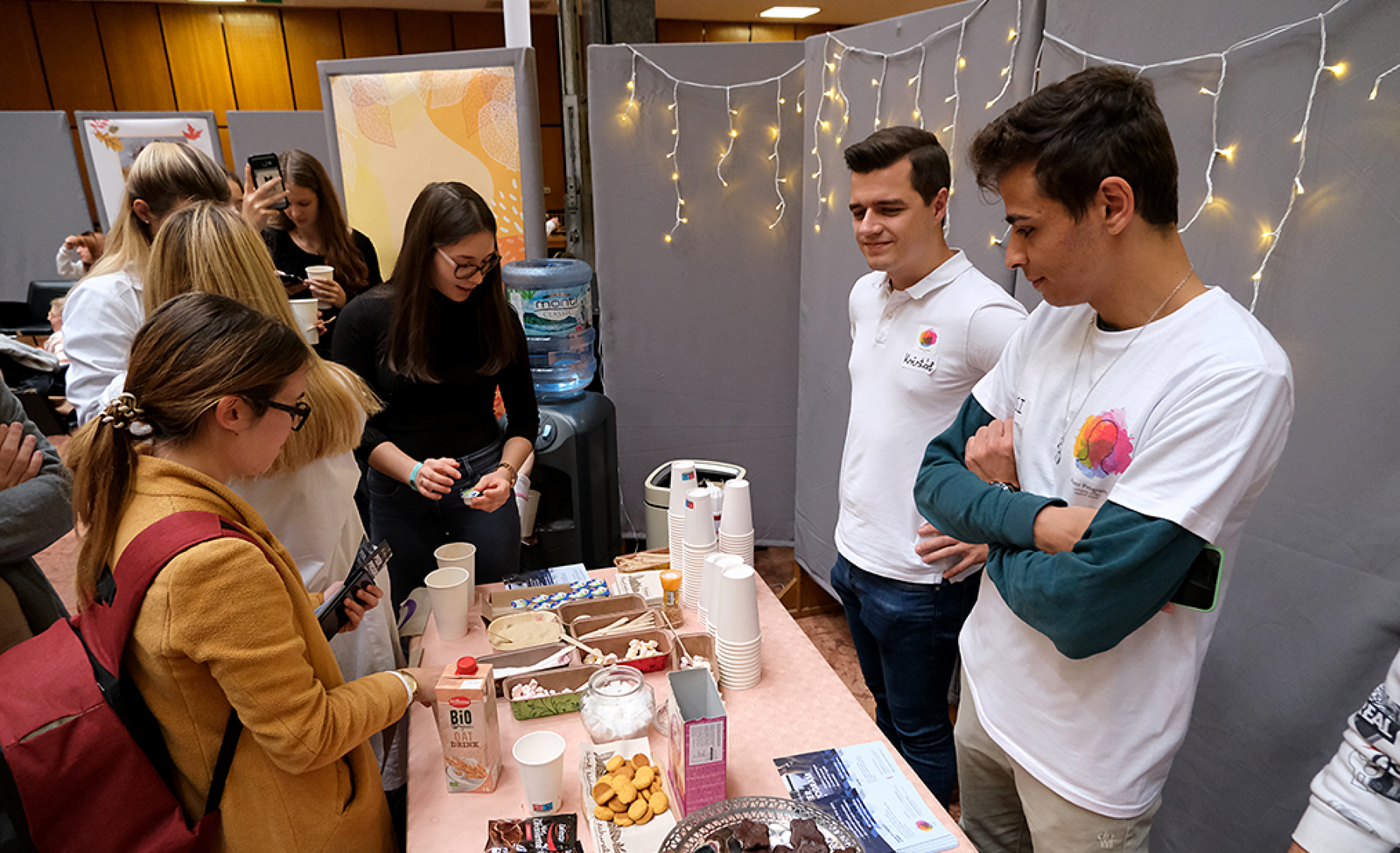
    P: Every semester we have a talk with the Dean’s office (particularly the VD of General Affairs and Student Welfare, Prof. Tényi) about how the programme could be modified or adjusted based on our experiences and observations from the previous semester. We also bring up any unique issues that came up and how the school could adjust its policy slightly in order to avoid the issues in the first place. We make ourselves available to communicate with students and address their problems in order to find an ideal resolution. We have events like “Chill with the Peers”, and Lemonade day at the Aula, where students can freely talk to the Peers in an informal setting and get to know us better. This helps them feel more comfortable contacting us in the future, if needed.

    Q: Okay, and how are students paired up with Peers?

    A: On the website, we are listed with a short description of us and as I previously said, our ‘specialisations’. Based on that, once you click the ‘Contact Us’ button and select for your particular issue, the website filters for the relevant Peers that you could be matched to and you can send a message for the Peer you end up choosing.

    Q: Wow, that’s really cool. It sounds well-organised. So what do you do when you can’t help a student, in cases where you are unsure what to do?

    “A good Peer has to be empathetic and caring, and most importantly has to possess a wide range of knowledge on the problems a student could face…”

    P: The Peers have a group amongst ourselves, and with permission we can share the problem on that group. Usually there’s at least one other Peer who knows the solution and can assist. Also, our organisers from the student office are in the group and know what to do (especially in legal matters that may require language or local legal knowledge).

    Q: How much time does it take up per week? Is it something a final year student can participate in or would it be too time-consuming?

    P: Per week, I’d say an hour or so. It really depends on how many students you are dealing with and what the issues are. A final year student is an ideal participant in this programme since at that stage they would have come across a wide range of issues and are therefore thoroughly equipped to assist lower-year students. It’s also not terribly time-consuming alongside the rotational year schedule.

    Q: What kind of events are the Peer programme in charge of organising?

    A: Like I previously mentioned, there’s the Chill-with-the-Peers hot chocolate day, the Lemonade day, and for Christmas the Peer Santa Claus day. We also have events amongst ourselves in the Peer Programme.

    Q: Alright. Let’s talk about the ideal Peer. What qualities would you say make a good Peer?

    P: A good Peer has to be empathetic and caring, and most importantly has to possess a wide range of knowledge on the problems a student could face with regards to immigration issues for the internationals, issues with the R.O and NEPTUN, exams, etc.

    Q: Are there any pros of joining the programme?

    A: Well, you get to develop those teamwork skills, working with the other Peers. You are also able to help others, which is a big way to give back to the student community. The programme offers a scholarship which means you get paid. I wouldn’t say the money is enough to be an incentive on its own but it’s still something if that means a lot to someone.

    Q: Any cons?

    P: I wouldn’t really use the word “con”, but it can be a bit difficult at times when you have your own exams and commitments, and at the same have to help someone else. So I would say having good time management and a freer schedule definitely makes things easier for a Peer.

    Q: Completely understandable. I would have a hard time balancing 2nd or 3rd year courses and having to attend to freshman issues in week 13 of the instructional period.

    P: Exactly.

    Q: So have you had any memorable experiences as a Peer?

    P: There’s not one in particular that I can pick out but in general, it’s truly heart-warming when a student acknowledges that coming to us Peers was worthwhile, and even recommends us to their friends. Many students are shy and hesitant to open up to strangers, so it helps that we rely heavily on word-of-mouth within our community. In a way, it’s like a reward system—positive outcomes motivate us to keep doing more.

    Q: Fantastic! And are there any new events or programmes that students can expect from the Peer programme this semester that you can share?

    P: We will have more events in the main building this semester, as well as having more flyers around the school premises to keep our contact with the student community. So stay tuned! Freshmen who who missed the orientation week can still get the chance to meet us.

    Q: Okay, and is there anything else you would like to add?

    P: The Peers are all in different years, different faculties and different nationalities. They have their areas of specialty as well, so my advice to students is to read the bio of the peers thoroughly, so you can streamline your search about which exact peer to contact, since some will have more knowledge about the topic of interest than others. This just helps you get better information quicker. For those interested in joining the peer programme, just apply. You have nothing to lose and we welcome all our Peers with open arms. You won’t be doing this alone.

    Q: Thank you so much for all this information, and for sharing your experience.


    As I said previously, the call for applications is already out and closes in just a day so hurry, hurry, hurry! The deadline is this Friday, 23:59.

    The official requirements state that you need to be an active student with at least two completed active semesters at any of the courses the University of Pécs Medical School or Faculty of Pharmacy. Current PhD students who received their M.Sc, M.D., D.M.D or Pharm.D. from our university are also eligible.

    You will need to fill the application form together with a motivational letter (500-character min.), after which you can be called for an oral interview.

    I personally think it’s a relatively low-stakes extracurricular to involve yourself in. You get to connect with fellow students and this only evolves our little PTE student bubble for the better. It also gives you the opportunity to practice some of those soft skills you will eventually need in your own career whether you go into clinical practice, research or something completely different. Take the opportunity to diversify your experience!


    Author’s note: My sincere appreciation goes to Prithvi for agreeing to be a part of this blog post and giving us his perspective on this topic.

  • Extracurriculars: EGSC

    Extracurriculars: EGSC

    Today’s about our favourite student body, EGSC!

    I’m genuinely excited to discuss the EGSC because it’s a topic that tends to spark a lot of debate. Everyone seems to have an opinion about what’s going wrong or what needs to change within the council.

    Personally speaking, my two years in EGSC were among the most dynamic and challenging experiences of my extracurricular journey, yet they proved to be the most rewarding. By the end of this piece, I hope you’ll see why joining them is a decision worth making.

    So what’s EGSC anyway?

    EGSC is the student representative body in ÁOK for the English and German programs. This covers the medical school students and- surprise, the pharmacy students! Yes pharmacy students, you are absolutely entitled to be a part of this body.

    And what do they do?

    Their main role is to act as a liaison between the university and the students. They address student issues- academic and personal, conveying them when necessary to the appropriate authorities and finding a solution for the student body. And as you may know by now, there’s the event organisation: the White Coat ceremony, Tea & Talk, International Evening, Motivational Speech, amongst others.

    A little bit about my experience.

    I was in EGSC for 2 academic years serving in the capacity of PR rep. At the time, there was a concern that this role would not be able to be filled because of how skill and time-demanding it is but a good friend who knew about some of my hobbies thought I could be useful in PR and urged me to apply. I applied and just as was thought, I was the only PR applicant. I fell into the role quickly and essentially hit the ground running. In that time, I had to make social media posts and event posters. I had to learn how to optimise images for certain displays and even some video editing was required here and there. I made myself available to attend most (if not all) EGSC events for media purposes. It took a bunch of my time and I had to learn how to manage my schedule and balance the duties with academics. Sometimes the two overlapped but that was okay because I thoroughly enjoyed it. As it turns out, walking past a poster in uni that you spent 2 hours working on the night before gives you a dopamine rush.

    As a member of the board, I also had to participate in board activities. These ranged from organising the new white coats for the new 3rd years or taking the new students around the campus during orientation to having meetings with faculty or guiding a student on how to set up and access Amboss.

    There was also critique- hardly ever in person- just online. Because EGSC acts as a representative body for the students, they are also the first line of attack when students do not necessarily get the outcomes they desire. In truth, a student body is also limited in many ways and this one does the best with what they have. It was never taken personally, even the nasty digs, and we just did the best we could as a team. I still recognise it as one of my best moments in PTE. I encourage any student to apply and be able to contribute to the student body.

    Who can join EGSC?

    All active students of the Medical school or Faculty of Pharmacy are eligible to apply. Just as a side note, presidential applicants should either have been an EGSC member for a year already or been a year representative for 2 years.

    EGSC members of the previous board who would like to continue in the following year also have to re-apply, so all positions are really open to any student.

    Can first-year students join?

    Technically, you can. There’s nothing stopping you but I really would not advise joining EGSC in your first year. First year is such a fundamental year where you are trying to find your footing. EGSC activities require anticipating certain situations and planning ahead a lot. This can be a bit difficult to conceptualise if you do not have a first-hand idea of what’s going on. It’s been done before, don’t get me wrong but I think you put yourself and your academic goals at a disadvantage volunteering in such a big way in your first year.

    What posts are available in EGSC?

    • President and VP positions (2 each for the English and German programme): They primarily handle executive roles, delegation duties and academic concerns. They are often in closest contact with university leadership. If you have an eye on this role, you need to come with charm and charisma. You need to have good communication skills and be quick-thinking. Most importantly, you should know how to advocate for your fellow students.
    • Communication contacts (2 for the English and German programme): They are in charge of all things communication- emails, social media, etc. They also create the What’s Up in Pécs posts, keeping students abreast of planned events in Pécs. I would say if you have your eye on this role, you have strong organisational skills, time management and, of course a strong command in whatever language you are studying in. Emails are not sent only in response to students, but also to faculty leadership, external bodies, guests of the university, etc.
    • Dentistry representative: This role is reserved for a student from the dentistry programme who can advocate for the dentistry students. This role is relatively new and was introduced to bring the board’s attention to any issues faced by students in the dentistry programme. You will need to be an advocate for students where you see dentistry students not receiving as much support or help. The role as introduced when it was observed that the board was overwhelming full of GM students who did not have as much knowledge of the goings-on in the other programmes. It is a dream that it would one day be redundant, but till then…
    • Pharmacy representative: Similarly, this role is reserved for a student from the pharmacy programme who can advocate for GYTK students. The role is the same as that of the dentistry rep.
    • PR representative: This role is not language or programme-specific. This role can be quite time-demanding, speaking from experience. The PR rep makes the pretty social media posts and the posters that go up in the university and are flashed on the monitors in the university. Around the time of events, even more work is required in the position. If you have an eye on this role, it’s imperative that you can read and summarise large bits of information to smaller bullet points. You should have an eye for detail and basic design skills. You will need to use certain design programmes like Canva, Adobe Illustrator, even some video editing programmes (iMovie, Final Cut pro,) etc.
    • Secretary: This role is not language or programme-specific. If you have your eye on this role, you should also have strong organisational skills and time management. You will be required to make agendas, plan meetings and take minutes of internal and external meetings and sometimes assist with task allocation.
    • Treasurer: Also not language or programme-specific. This role was once in charge of financial duties. Due to a change in how financial responsibilities are handled, the role is now more of a miscellaneous role, assisting the other members in their roles, especially PR as it can be quite time-consuming. So it is beneficial to have a similar profile as PR and even communications contact.

    How can I join EGSC?

    A call for applications will be put out, typically in the first 2 weeks of the new academic year (so anytime now). Usually a CV and a motivation letter is requested and then all you have to do is wait for the elections.

    What does the election process look like?

    As far as I know, it has always been an electoral process conducted by the group leaders and year representatives. Candidates for each position are asked to prepare a small campaign speech and pitch themselves, after which the attendees (group leaders and year reps) vote. Votes are counted and the new board is announced shortly after the voting process is done.

    I will add that I am not so much a fan of this method as it can quickly become a popularity contest. But I got to understand that there is an obligation for EGSC to open up voting to representatives of the student population- that being the year reps and group leaders, rather than internally conducted interviews for the sake of transparency.

    What are the perks?

    EGSC offers multiple opportunities to develop essential soft skills like leadership, time management (I never needed a planner till I joined!), teamwork, communication, and conflict-resolution- skills that are valuable in both social and professional settings.

    You also have the chance to make a difference, even in small ways. EGSC runs an open-door, walk-in service service throughout the academic year, where students come in with a variety of concerns. Depending on the issue, you could help by simply offering a listening ear and a supportive hug, or by taking more involved actions like accompanying them to the registrar’s office or sending an email on their behalf.

    Another rewarding aspect is being part of the behind-the-scenes work for some of our most popular events. Watching weeks of preparation come to life from the ground up gave me a deeper appreciation for the relationship between hard work and tangible results.

    Working with students from different programs also exposes you to the inner workings of the educational systems within PTE and widens your understanding.

    Lastly, being an EGSC member can boost your Erasmus or POE exchange program applications, giving you an edge with extra points for participation.

    Any cons?

    One downside is the time commitment, which varies depending on your role. Some positions require more time than others, but all roles can become demanding. Even members with lighter duties often step in to support others when the workload becomes overwhelming.

    A common question asked by students is whether EGSC is a paid extracurricular. To the best of my knowledge, up till now there is no remuneration for EGSC members. This is intentional, to attract those with genuine passion and drive to make a difference, rather than those motivated solely by financial incentives.

    Even so, none of these are peculiar to EGSC and many of our extracurriculars have similar cons. There’s a lot more to benefit than lose by joining EGSC.


    This brings us to the end of the piece. Keep your eyes peeled for the Call-for-Applications on EGSC’s Facebook and Instagram pages. I hope everything has been clearly explained, and I trust that when the application period opens, there will be a few more enthusiastic applications coming through.

    Stay safe!

    EDIT: Applications are currently open until 22nd September. Send your CV and motivation letter to egsc[at]aok[dot]pte[dot]hu. This year, not all positions are open so check the listing here to see what you might qualify for.


    Author’s note: The views and opinions expressed in this piece are solely my own and do not represent those of any institution. Any conclusions drawn or interpretations made are personal and should not be attributed to any entity other than myself.

  • Extracurriculars: The Unibuddy Programme

    While we’re in the middle of summer, some of you might be fishing around for some extracurricular activities to join and enrich your student experience against the next academic year. We will be going through some in the next few posts. I personally have been involved in quite a few and can give some information based on my experiences. As you know, I always like to involve other students to get an unbiased opinion and then add mine to kind of top it off. The university has a relatively good selection and the best part is just about any student can join, as long as you have the drive and motivation.

    In this post, we are gonna be talking about the Unibuddies. I was a Unibuddy myself for a year and it was a really great experience. Today, I have interviewed a current 6th year student in the Unibuddy programme, and I will also be giving some information from my POV about it. So let’s get to it, shall we?


    Q: Thank you for being a part of this blog. Let’s start with a little introduction.

    A: Yes. So my name is Prithvi. I live in the UK although originally I’m Indian, and I’m currently a 6th year medical student at the University of Pécs.

    Q: Great! And for those who don’t know, what is Unibuddy exactly?

    A: It’s an online communication platform with your details where prospective students who are interested in academic positions at the university can contact you for more details regarding the admissions process, tips for the interview or any general questions regarding the city or even job prospects after graduating. We also sometimes have to take part in online webinars to advertise the University and answer any questions people might have.

    Q: When did you first become a Unibuddy and for how long have you been a Unibuddy?

    A: I have been a Unibuddy for one year. I believe October last year was when I officially started the programme.

    Q: What was the process of application like? How did you prepare?

    A: It was quite simple really. We had to fill out a form with our details and upload it. Since I was in the Peer Programme as well, I was exempt from the interview and got the position immediately, but I know some of my fellow Unibuddies had to do an official interview with representatives from the Dean’s Office.

    Q: How many hours per week did you dedicate to it?

    A: I’d say about an hour a week.

    Q: Are there any perks of being a Unibuddy?

    A: It is a scholarship programme, so we get paid 15,000 ft per month for 10 months as part of the contract. Also, we have a chance to interact with other Unibuddies who are sometimes in other faculties, or even the ones from our faculty who are in a different year.

    Q: Have you had any negative experiences? Can you share them?

    A: Luckily I haven’t had any negative experiences. But since it’s an online platform sometimes people ask vague questions and when we give responses they don’t reply after that, which is sometimes … awkward!

    Q: What kind of person best fits the Unibuddy role in your opinion?

    A: I would say someone who is outgoing, knows the ins and outs of the major they’re in, as well as someone who speaks fluently to engage in online webinars and taking part in open days at the university.

    Q: Would you recommend this for even final year students?

    A: Yes, definitely!

    Q: Anything else you would like to add?

    A: The application for next year will be announced sometime in September, so stay tuned with the EGSC postings so you don’t miss out on the deadlines!

    Q: Thank you so much for all this information, and for sharing your experience.


    As I said previously, I was a Unibuddy in the same year as Prithvi. We essentially acted as student ambassadors or representatives for the university. The call for applications was put out sometime in September. We had to submit a motivation letter and fill in an official form.

    After your application is assessed, you get invited to an interview. Based on your experience, the interview could be waived. In my case, it was waived because I was a student ambassador (basically a similar role but working with the International Center) for 2 years prior and had actually worked in a similar capacity and with the same Unibuddy platform.

    Once you are approved, you will be invited for a photoshoot to build your Unibuddy profile. You will also be asked to provide a few words about yourself and academic journey at UPMS that will be on the uni website. Here you can access the page of the current Unibuddies to see what to expect.

    Once your profile is set up, you are ready to begin. You will get an intro course about Unibuddy, how to use it and general communication guidelines but aside that, you are now acting as the student liaison between prospective students (and sometimes family) and the university. You won’t always know the answer to some of the questions asked. Sometimes, just a little research is enough to find the answer. You can also ask in the common group with your fellow Unibuddies, you can ask the managers of the programme and you can reach out to the Admissions office to clarify something. I personally reached out so many times to the Admissions office and got very helpful answers.

    Because the student ambassador programme runs concurrently with the Unibuddy programme, you often get students inquiring about other courses that are not offered in the medical school. If the questions are easy enough or you know the answer you can answer them yourself, but when they get specific, it might be more beneficial to refer them to someone else in the programme. On the Unibuddy platform, you are also able to make blogposts and videos to provide more information on the platform. During the academic year, you might be asked to participate in webinars or Open Day events where the office comes in contact with interested students, so that is always a good opportunity to participate in and represent the school.

    All in all, I would say an extra-curricular, this is a pretty easy, mostly low-effort one and if you apply yourself, you can really benefit from the opportunities to improve your presentation skills, public speaking, writing, etc. I did it in my final year and it did not take a toll on my schedule even one bit, so final year students are also encouraged to apply.

    At the end of the year, we had an appreciation dinner and received certificates which was very nice. This past academic year was the first time (to my knowledge) that the programme was run within the medical school and as a previous ISA, I will say I preferred the Unibuddy programme because everything was just a bit more tailored to the medical programme which I am familiar with.

    So that’s that. If you are interested in working as a Unibuddy, keep your eyes open for the call for applications coming in September.

    Author’s note: I would like to extend my gratitude to Prithvi for his willingness to participate in this blog post.

  • Rotational Year: Internal Medicine, the Case Reports and Exam experience.

    Rotational Year: Internal Medicine, the Case Reports and Exam experience.

    Hi 6th years,

    As promised, I’m bringing to you a sample of my case reports for the Internal Medicine rotation. Internal Medicine was my first rotation and none of us really knew what exactly was expected of us with regards to the case reports. It also didn’t help that the course description on NEPTUN asked for 2 case reports weekly, which after the 8 weeks would mean 16 case reports in total, and the departments themselves were saying something different. But after consulting with the secretary, I confirmed that only 8 case reports are needed and the course description document needs to be corrected.

    Here you can find a SAMPLE of what some of my case reports looked like and here, I have added a template that you can download to use for yours if you would like to order your cases as so.

    To be honest, I wasn’t asked much about my case reports and most examiners did not seem to care about it. It was used to choose topics for me once. I was in the nephrology department so one of the examiners skimmed through my reports, found a chronic renal failure case and chose the CRF topic for me as my third oral topic. But nothing really related to that patient case itself.

    To talk a little bit about the exam itself, I do remember it being a bit of a nerve-wracking experience, I have to say, both the studying process and the exam itself; nerve-wracking for the amount of details you have to remember but somewhat satisfying being able to make connections amongst the different disciplines. I had mine in the 1st department and I actually had a B chance in internal medicine as I had a goal grade in mind for this course (which I achieved the second time around). I don’t necessarily recommend gambling like this with internal medicine if you’re not too strong in it or willing to study as hard more than once but it’s completely doable.

    Anyway, to the exam.

    My A chance

    Practical exam in the haematology ward

    Case: Microcytic Anemia

    • Explained all the information obtained from the patient.
    • Asked about co-morbidities (pt had DM, atherosclerosis, heart failure and a pacemaker and previously had a PCI procedure)
    • Asked for the causes of microcytic anaemia
    • Asked for first investigations in microcytic anaemia (be sure to mention DRE)
    • Asked for symptoms in microcytic anaemia .
    • Asked what one would look for in the DRE.
    • Asked what lab parameters to check.
    • Was quite particular about the full names of acronyms like PCI and PTA.
    • Asked me to examine the heart on the patient, asked where I would hear murmurs, asked where I would hear the aortic valve.

    Other students got T-lymphoma and TTP patients. The practical went great and I could answer all the questions.

    Oral exam with a gastroenterologist and a cardiologist.

    My Qs: Essential Hypertension and IBD + GI precancerous lesions (Easy enough or so I thought)

    Was given time to write down everything I knew. I presented everything I knew before I was asked questions.

    • Gastroenterologist wanted to know under what condition we give mesalazine in CD: only if colon is involved (This, I couldn’t answer).
    • ALL indications for colectomy in UC (This, I didn’t give all the answers). 
    • Complications of both UC and CD, combined and separate( This, I didn’t give all the answers). 
    • Epidemiology was important for essential hypertension (This, I messed up).
    • The cardiologist wanted to know the target of hypertensive treatment in essential HTN: I started to mention the different patient groups and different targets and could see we were not in agreement (which is weird as it is in the lecture).

    At this point I could see I risked a low grade and opted to end the exam here and come back again. Overall, the examiners were quite patient and kind and let me talk, but take note of the details in 1st department.

    My B chance

    Practical exam at the GI ward.

    Case: Alcoholic cirrhosis with ascites. 

    • Immediately started with the ECG which I did not expect as no one cared about the ECG up until now (so go through it, just in case- better safe than sorry). Asked for rhythm, rate, PQ interval analysis, axis, voltage- nothing more complicated.
    • Asked about all the causes of ascites, cirrhotic and non-cirrhotic (He had to pull a lot of info out of me as I was nervous after the ECG).
    • Asked for the most common cause of ascites in Asia.
    • Asked for the puncture site of ascitic fluid.
    • Asked for what we check for after paracentesis (for some reason, he was not happy when I said tumor markers even though Amboss and other academic sites state this, don’t forget cytology)
    • Then I described all I knew about the patient. 
    • Asked me about metabolic causes of cirrhosis: hemochromatosis and Wilson’s.
    • Asked which was which and then focused on hemochromatosis: what mutation, what it means for iron uptake, how we treat.
    • Took me to the patient and asked me to percuss the lungs. Asked what we look for. 

    Overall, he was quite impatient and did not give much room to think but was fair in his grading based on my performance.

    Oral exam with the endocrinologist and gastroenterologist.

    My Qs (3 this time): Differential diagnosis of chest pain, GERD and Chronic Kidney Failure. (CRF was chosen based on one of my case reports)

    Was given time to write down everything I knew. I presented everything I knew before I was asked questions.

    • Mentioned all the possible causes of chest pain: pulmonary origin, cardiac origin, GI origin. They were quite happy that I organised it in this way so it was off to a good start.
    • Asked about 2 acute causes that I forgot: Aortic dissection and Pneumothorax
    • Asked the difference between angina and AMI: AMI lasts longer and is not relieved by pain killers.
    • How we would manage AMI? MONA
    • Reflux vs GERD: GERD is when reflux causes troublesome symptoms.
    • Asked for how common it is.
    • Asked for simple way to test it: PPI test
    • Other diagnostic methods: 24hr pH measurement, barium swallow, manometry of LES tone.
    • Complications of GERD.
    • Pharmacotherapy of GERD.
    • What kind of surgery can we do?
    • Describe chronic renal failure, what is the GFR like?
    • Causes of CRF. 
    • Symptoms: based on all functions affected, so glomeruli function, tubular function, EPO and Vit. D.
    • What do we do? renal replacement therapy
    • List the RRTs you know.

    That was the end of the exam. Other students were waiting because they were asked to wait outside and told that we would all receive our grades at the end. 2 minutes after I came out, we were called in one by one and given our grades privately and congratulated. 

    The examiners were nice here and assisted with helping questions especially if you were already on the right track. Good experience overall.

    That being said, for this exam I suggest you try not to be too hung up on getting a particular department. I know most students like to go for the 2nd department but you still need to study just as hard to succeed regardless of where you take the exam and these are pieces of information you must remember in your career anyway. For my first exam, I was the only one who had to come back for a B chance and the day I had my second exam, all of us passed with good grades (as I was told anyway). Both were in the first department as I already said.

    Work hard, repeat learned material and be confident. You can do it- after all, you got this far. Good luck.

    Author’s note: The content shared on this blog, including the project and any related materials, is intended solely for informational and educational purposes. No permission is granted for the use of my work in any form without explicit written consent.